Ask which kind of durability matters.
A reader considering a second citizenship may ask whether the passport will still be useful in ten years. That question contains several different concerns: whether the state will continue, whether citizenship remains valid, whether the passport can be renewed, and whether other countries will continue granting convenient access. Those outcomes do not move together automatically.
Vanuatu’s regional relationships are relevant to the first concern and can influence the others. They show a sovereign state participating in continuing diplomatic, development, security, and people-to-people arrangements. They do not establish that a particular citizenship program will keep its present terms or that another government will accept every category of citizen on identical visitor conditions.
A useful assessment therefore keeps the country, the program, the document, and destination permission separate. Otherwise an accurate statement about Australian aid can become an unsupported claim about Australian entry. The evidence is more valuable when it is allowed to prove the narrower point it actually supports.
The Forum provides an institutional setting.
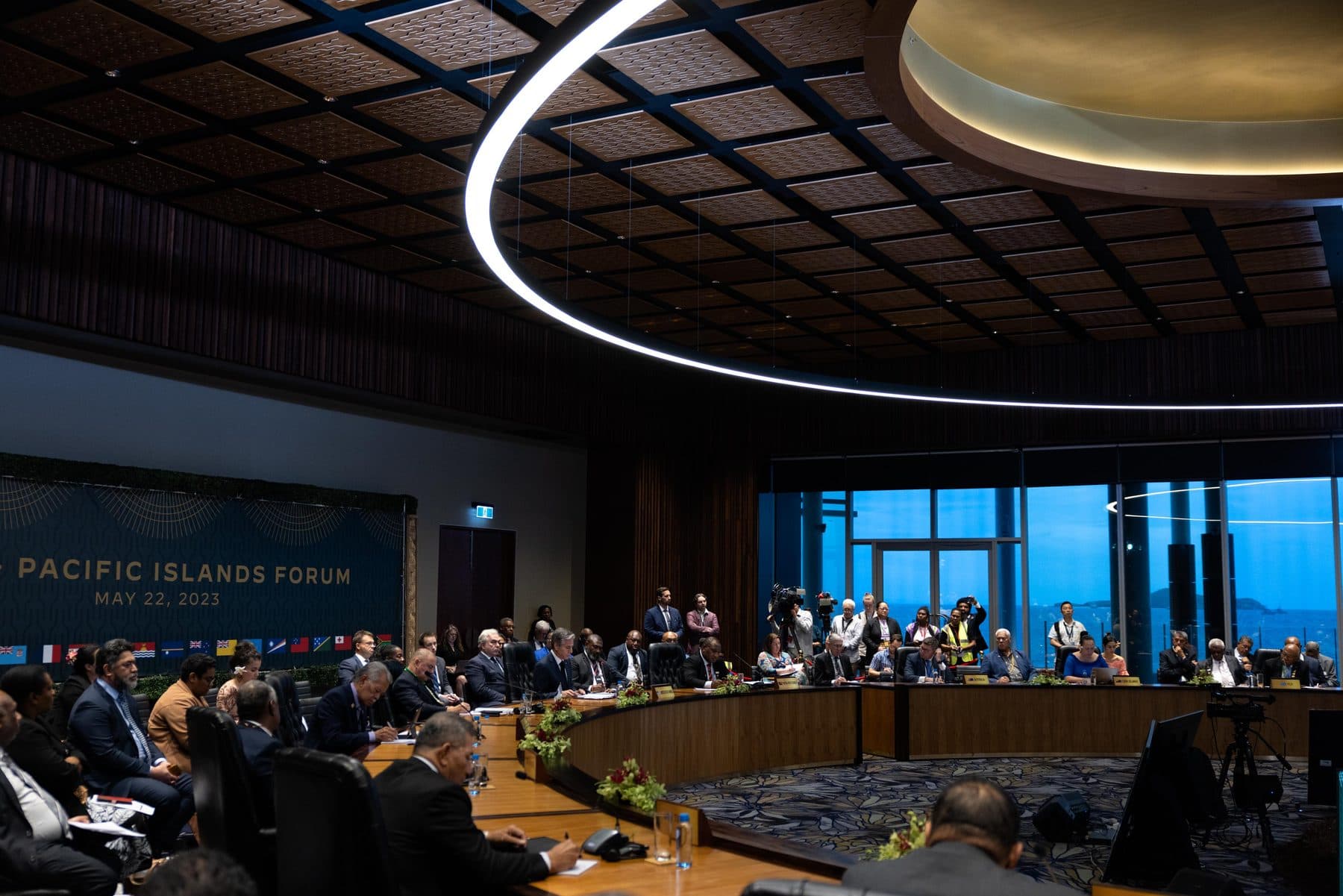
The Pacific Islands Forum brings Vanuatu into a regional process with neighboring governments, including Australia and New Zealand. Its communiqués address issues that extend well beyond investment migration: climate, economic development, regional cooperation, and the institutions through which members work together. Citizenship buyers should read that context as national context.
The official communiqué records the fifty-fifth Forum in Koror, Palau, from 31 August to 3 September 2026. Vanuatu was represented at ministerial level. Paragraph 74 endorses Vanuatu to host the fifty-ninth Forum in 2030, coinciding with the country’s fiftieth independence anniversary. The dates and the host endorsement are specific, checkable facts.
The inference is modest. Other governments plan to continue dealing with Vanuatu through a regional institution. A future host role is not a prediction about which cabinet will govern, which program rules will apply, or whether a particular applicant will be approved. It is one piece of evidence about the country’s continuing place in the region.
Australia’s partnership has practical substance.
Australia’s Department of Foreign Affairs and Trade describes Australia as Vanuatu’s largest development and humanitarian partner. Its published program covers areas including health, education, infrastructure, governance, policing, and disaster recovery. That record is more informative than a general claim that Vanuatu has powerful friends.
The relationship also has limits. Assistance depends on programs, decisions, capacity, and the circumstances of a request. It does not make every public service immediately available or eliminate the practical consequences of a cyclone or earthquake. A person considering residence should still examine local healthcare, transport, communications, and contingency arrangements.
For a citizenship assessment, distinguish institutional support from personal delivery. A development partnership can strengthen national capacity over time. It cannot guarantee a particular passport appointment, a medical evacuation, a bank account, or the uninterrupted operation of an office. Those are separate operational questions requiring their own evidence.
Read the Nakamal Agreement as a legal instrument.
Australia and Vanuatu signed the Nakamal Agreement in Canberra on 29 June 2026. Its published text addresses policing, humanitarian assistance, security, infrastructure, and mobility. Article 12 makes entry into force depend on an exchange of diplomatic notes confirming completion of the parties’ requirements. Signature alone does not establish that this condition has occurred.
The text includes a prohibition on foreign military bases or infrastructure, consultation on third-party involvement in critical infrastructure, and arrangements concerning disaster assistance through the FRANZ partners: France, Australia, and New Zealand. Those provisions should be described according to their wording and effective status, rather than enlarged into an unlimited Australian guarantee.
For the passport reader, Article 6 is particularly relevant. Alongside enhanced visitor mobility, it requires effective mechanisms to distinguish citizenship by investment from other citizenship and provides for annual review of mobility arrangements. It does not itself grant an individual visa. Verify the operational immigration rule for the traveler instead of treating the agreement’s title as entry permission.
Country confidence and program treatment can diverge.
A partner can support Vanuatu’s institutions while imposing additional conditions on investment citizens. There is no logical contradiction. A development relationship addresses national priorities; immigration policy addresses the receiving country’s own entry decisions. The same government can pursue both positions at once.
This matters when evaluating a sales argument that moves from regional cooperation to passport desirability without identifying the missing rule. Ask which right is supposedly created, for which category of citizen, from what effective date, and through which process. If those answers are unavailable, the benefit remains a possibility or policy direction rather than a usable entitlement.
A hypothetical family needs regular access to Australia for care and education. The existence of a bilateral partnership is relevant background, but the family’s decision depends on the actual visas and permissions available to its members. A favorable diplomatic development cannot substitute for those individual approvals. Compare the arrangement that solves the family’s need, even if it is unrelated to a citizenship purchase.
New Zealand’s relationship is visible in ordinary institutions.
New Zealand’s Ministry of Foreign Affairs and Trade records the establishment of its High Commission in Port Vila in 1987 and a bilateral Statement of Partnership signed in 2023. Its relationship page describes work in public services, governance, economic activity, climate resilience, and humanitarian assistance. These are continuing connections rather than a single headline.
The ministry’s country plan also describes Vanuatu’s importance to the Recognised Seasonal Employer scheme. It records approximately 6,800 ni-Vanuatu participants during 2023 to 2024, around 40% of that workforce. Those are figures for that period, not a current headcount or a promise that a newly naturalized citizen qualifies for any particular labor program.
The relationship illustrates why a country can matter regionally beyond its investment program. Families, workers, institutions, and development partners create connections that persist across news cycles. The planning implication remains bounded: investigate the particular route and eligibility requirements before turning the wider relationship into a personal mobility claim.
Other relationships need the same evidential discipline.
The United States officially opened an embassy in Port Vila on 19 July 2024, according to the State Department’s Office of the Historian. That establishes a diplomatic milestone. It does not establish a US security guarantee, unrestricted consular services at that post, or a special US immigration route for Vanuatu citizens.
The same discipline applies to discussion of Chinese infrastructure, French regional interests, or disputes between states. Identify the agreement, project, official statement, or court document supporting the claim. A proposed instrument is not a signed treaty. A credit relationship is not proof of a military base. A court filing is not a judgment.
For a personal decision, ask whether the development changes a concrete dependency. Does it affect the route you need, the place you intend to live, the institution holding your assets, or the services on which your family relies? Geopolitical commentary can be interesting without supplying a reason to buy or reject a particular citizenship.
Travel policy has already changed independently.
The United Kingdom imposed a visa requirement on Vanuatu nationals in July 2023. The European Union ended the visa exemption permanently in December 2024 after an earlier suspension. These decisions demonstrate that access can change while the issuing state continues to exist and maintain diplomatic relationships.
The correct conclusion is neither that the passport has no use nor that the change is irrelevant. Identify the journeys affected, the additional applications required, and the rights the reader already holds. A household traveling mainly within parts of Asia and the Pacific may reach a different practical assessment from one needing frequent British or European visits.
Do not build a long-term plan around an assumed restoration. A future policy change should enter the analysis when there is an operative rule and a clear scope. Until then, use the permissions currently available and retain a workable alternative for essential travel. Optimism about diplomacy should not be the only contingency.
Distinguish citizenship continuity from document administration.
A citizenship grant, a passport’s validity period, and a renewal process are different matters. Continuing nationality does not keep an expired document usable. A lost booklet does not by itself establish loss of nationality. The relevant law and administrative requirements should be checked for the event that has actually occurred.
Vanuatu’s published Hong Kong consular procedure covers in-person biometric steps for new passport applications and renewals or reissues. That is a practical reminder that maintaining a travel document can involve attendance, records, and scheduling. Regional partnerships do not remove those requirements.
Keep the original citizenship evidence, civil records, and a renewal calendar. Verify the office and process before planning a trip around a future document. A durable nationality can still be inconvenient to use if its holder neglects the evidence and administration needed to obtain the next passport.
Make a resilience assessment with several scenarios.
Instead of predicting one political future, test the plan against a small set of plausible changes. What if an application takes longer than expected? What if a destination adds a visa requirement? What if travel to a passport office becomes more expensive? What if the household’s preferred residence becomes unsuitable?
For each scenario, identify the consequence and a practical response. The response may be keeping an existing nationality, maintaining valid residence elsewhere, reserving funds for travel, or preserving records that support a visa application. Do not confuse the number of passports with the number of workable alternatives. Two documents can still depend on the same essential route.
This approach also makes costs easier to assess. A citizenship may be worthwhile because it adds a meaningful national connection even without improving every itinerary. Another reader may discover that the desired fallback is better supplied by residence permission or a different family arrangement. The country analysis should help distinguish those cases.
Separate facts, inferences, and unresolved questions.
A disciplined note can have three short parts. Record the verified institutional facts, explain the inference you draw from them, and identify what remains unknown. For example, a published partnership supports an inference of sustained engagement. It does not establish how every future government will implement it.
This prevents a confidence judgment from becoming a disguised guarantee. The same method should be applied to any country under consideration, including larger and more familiar states. Vanuatu deserves scrutiny on its actual record, with neither romantic exceptionalism nor the assumption that a small population means an invented institution.
Citizenship is also a relationship with a society.
Regional analysis should not reduce Vanuatu to a strategic location between larger powers. It is a country with its own institutions, communities, priorities, and political choices. A person considering its nationality should understand those features rather than assessing the state only through the benefits another capital might provide.
That understanding also improves practical planning. A household considering residence needs to examine daily life and local obligations. A non-resident citizen needs to maintain documents and understand the limits of status. Neither role comes with cultural knowledge simply because an application succeeds. The useful long-term connection is built through informed participation and continuing responsibility, not through a geopolitical prediction.
The whole picture
The Bitcoin Lawyer take
Read the agreement or official measure behind a claim about Pacific access. Establish who benefits, for which purpose and under what conditions.
Longstanding diplomatic relationships deserve attention on their own terms. A household should value only the travel or residence rights it can verify under the current arrangements.